

Choosing Delrin chain and sprockets: a simple gearing guide

A chain drive is one of the simplest ways to get power from a motor to the wheels, and it's forgiving if your motor and axle don't line up perfectly. Here's how to choose the right sprockets, without the headache.
Gearing made simple
Count the teeth on each sprocket, then divide the bigger number by the smaller one. The answer tells you how many times slower the wheels turn than the shaft driving them.
Example: a 12 tooth sprocket on the gearbox drives a 24 tooth sprocket on the axle.
24 ÷ 12 = 2, so this is a 2:1 ratio. The gearbox shaft turns twice for every one turn of the wheels
The wheels turn half as fast, with twice the pulling power.
Two sprockets the same size don't change the speed at all. That's handy when you just want to carry the drive to a second axle.
Quick rule:
Small sprocket driving a big one: slower and stronger. Good for shunters and quarry engines.
Big sprocket driving a small one: faster. Good for engines that need a bit of pace.
If you'd rather not do the sums, our speed calculator does it for you. Put in your motor, gearbox, sprockets and wheel size, and it shows the scale speed your loco will run at.
Match the bore to your shaft

The bore is the hole in the middle of the sprocket, and it needs to match your shaft. We stock four bore sizes:
Small sprockets only come with small bores, because there isn't room for a big hole. So if you need to slow things down a lot on a thick axle, put the small sprocket on the motor or gearbox side.
The chain
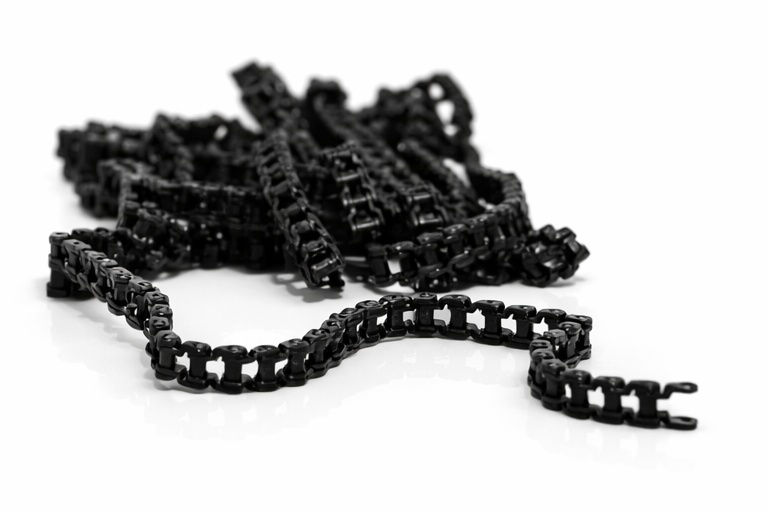
Our Delrin chain is sold in 12 inch lengths. The links snap together by hand, so you can make any length without special tools or master links. It weighs just 1.9g per foot and takes a running load of up to 907g, which is plenty for garden railway locos.
Not sure how much chain you need? Our chain calculator works it out from the distance between your two shafts and the two sprockets you've chosen.
Getting the tension right
The chain wants to be snug but not tight. You should be able to move it side to side about 1 to 2mm either way. Any tighter and it will bind and wear. Any looser and it can jump the teeth.
Not sure where to start?
Tell us your motor, your gearbox and your wheel size, and we'll suggest a pair of sprockets.
Stan
Comments